
Originally Written by A. Desmond Reeves for the Fall 1951 edition of Delta Phi Epsilon magazine.
If these intriguing words (which are not as ridiculous as they may seem) serve merely to entice you away from London for a few days the next time you visit England, they will have served their purpose adequately.
To many tourists the English countryside is merely a blurred image viewed through the smoke-clouded boat-train window as it speeds on its way up to London. I personally love London, it is a marvelous city and I hope some day to live there. However, London is in many respects a country within itself and in order to see the beautiful spots in, “This blessed plot, this earth, this realm, this England“, you must leave this teeming metropolis. Follow the oft-quoted Horace Greeley and, “Go west young man”, but in this case veer a little to the south or you will find yourself touring the Welsh coal mines!
The Cornish Riviera … absurd? Not quite, for in this area, which includes roughly the entire south coast of Cornwall from Torpoint to Lands End you will find palm trees and semi-tropical plants that grow outside the year round, however don’t expect a Nice or Cannes or you’ll be sadly disappointed.
If you have only a few days to spare there is an express train from Paddington Station London to Penzance – in my opinion the hub of Cornwall (the journey will take about eight hours), However, if you have more time and can’t beg, borrow, or steal a car, by all means go by bus. The view from the upper deck of an English bus is magnificent (you’d be surprised what else you see from the top of these buses!).
I suggest you follow the route that leads through such historic-filled places as Aldershot, Salisbury (the cathedral here is a “must” and a detour of seven miles will take you to Stonehenge), Dorchester (with its over-present memory of Thomas Hardy), Lyme Regis, Exeter, and Plymouth. Before crossing the Tamer River into the Duchy of Cornwall, the romantic minded among you will perhaps pause on the spot where the “Mayflower” embarked in 1633 and gaze out to sea from the Hoe of Plymouth as did Sir Francis Drake in the days of the Spanish Armada.
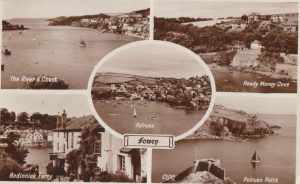
On your way from Plymouth to Penzance I heartily recommend you spend an hour or two in Fowey (pronounced Foy). This is a typical Cornish fishing village which has seen better days, but for quaintness and relatively unspoilt beauty it is second to none. Here the streets are so narrow and steep that the bus has to drop its passengers on the outskirts of town. If you are acquainted with the novels of Sir Arthur Quiller-Couch (“Q”) you will perhaps recognise this village as the “Troy” in many of his stories.
Penzance, as I said before is to me the hub of Cornwall. From here the beauty-spots of the Cornish Riviera are within easy reach. I wont attempt to enumerate the countless scenic quaint and historic spots I would have you visit, since If you go to Cornwall you have but to turn your head and they are all around you. However, I just cant resist mentioning a few of them.
Three miles from Penzance there is the most picturesque fishing village I have ever seen, Its name is Mousehole (pronounced Mouzle by the Cornish), here you feel as though time had stood still and were it not for electricity and running-water one could very well have been plunged into the fifteenth century.
From Mousehole it is possible to walk to Lands Ends but be prepared for an all-day journey. If you can spare the time it is well worth the effort and you will be rewarded many times over by the unparalleled beauty of the coastline. It is predominately jagged and rough, bit broken here and there by calm inlets with white sandy beaches.
Choose an over-cast day to visit Lands End (since at least 364 days of the year are over-cast here you won’t have much difficulty!) See it on such a day and you will undoubtedly experience the majesty of this most westerly portion of England. It is awe-inspiring with the sea beating against the jagged rocks and if you listen closely you can almost hear the ecstatic love-duet of Tristan and Isolde above the pounding of the waves.
If we, like the elephants, had to journey to find a resting place I would nominate St. Just-in-Roseland as my choice. This little churchyard with its silent headstones is a combination of superlatives can be reached from Penzance via bus to Falmouth, thense by ferry to St. Mawes and finally a two mile walk measured in Cornish miles (which seem like five of ours).
The pirates have long since departed Penzance but they live on in legends and folklore. In many of the sea-coast villages the hiding places of both pirates and their more recent counterparts, smugglers can be seen.
Throughout Cornwall you will find traces of age-old superstitions. They like the Cornish people themselves change little with time. Practically every home has the Cornish litany above the bed: From goulies and ghosties and long-leggetty beasties and things that go bump in the night – Good Lord Deliver Us.
=o=o=o=o=o=o=o=o=o=o=o=o=o=o=o=o=o=o=o=o=o=o=o=o=o=o=o=o
Confuscius says: Better Halitosis than no breath at all.
=o=o=o=o=o=o=o=o=o=o=o=o=o=o=o=o=o=o=o=o=o=o=o=o=o=o=o=o